Showing posts with label Croatia. Show all posts

Saturday, June 7, 2014

The Soaring Symphony of Dubrovnik

Partway through Beethoven’s 7th Symphony, the music swells from the alpine French Horn theme to full orchestral voice.  The string section’s bows reach to full sweep and the musicians lean in towards their music, brows furrowed in concentration. 
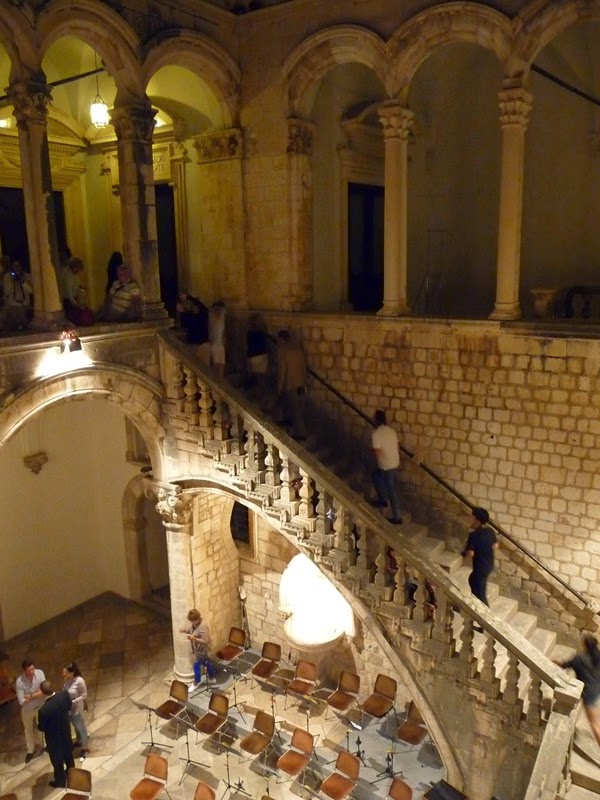
The marble columns of the antique courtyard swell with the power of the small orchestra, the arcade’s romanesque vaults grow taller and the marble angel over the palace entrance appears to turn his head and smile. 

The small audience holds its collective breath as the music reaches forte fortissimo, many closing their eyes as the rich tones of cellos and basses, bassoons and kettle drums envelop them.  And it ends.  There is silence.  The audience exhales and erupts in applause.  And the small stone courtyard glows with happiness. 

On our last night in Croatia, we attend a concert of the Dubrovnik Symphony Orchestra, held in the open courtyard of the 16th century Rector’s Palace.  It’s an evening that encapsulates so much of what we have learned about the country in the past few days. 


Dubrovnik was founded as a Roman outpost on an island secure from the marauding Slavs.  An independent City State for much of its history, it evolved into a sea power that rivaled Venice.  The current solid stone uniformity –  an almost Disneyesque perfection – resulted from organized rebuilding after the earthquake of 1667.  It wasn’t conquered until 1808 when its citizens turned the town over to Napoleon as he confronted the Ottoman Turks, rather than see their beloved home become a battleground.


But the long history of the “The Pearl of the Adriatic” has a much more recent and tragic chapter.  The city walls were needed to defend the city when Croatia declared its independence in 1991 and the Yugoslav Army laid siege.  Rather than relinquish control, a rag tag militia was raised and the city defended – but at great cost.  Hundreds died and historic buildings and artworks were destroyed in bombardment from nearby highlands.


Today, museums explain the confrontation with a strong Croat slant, but the most impressive memorial is the magnificent reconstruction of the inner city. 


Today the still solid walls encompass the polished stones of the Stradun – the broad main avenue that starts at the huge Onofrijeva fountain (bringing a secure source of fresh water from the hills above) and links the Franciscan and Dominican Monasteries (which catered to the poor and the wealthy respectively) before turning right at the city hall and bell tower, passing the Rector’s Palace (the elected city ruler) and ending at the cathedral. 

On the seaward side, stone lanes are lined with handsome buildings housing smart apartments, sidewalk restaurants and fancy shops catering to hoards of cruise ship tourists.  

On the landward side, steep, shoulder-width stairs are lined with a hodgepodge of everyday dwellings – windows and doors open to catch the occasional sea breeze, laundry hanging where it can over head, children’s shouts echoing from unseen play. 


The unifying attraction is the hour-long stroll around Dubrovnik’s unbroken walls - an opportunity to study the city’s maze of rooftop and lanes, spot landmarks, gaze out over the robust multi-tones of the Adriatic and up at the sheer, barren slopes of Mt. Srd.  We did it late in the day when the glow of the descending sun bathed the buildings in a golden light and cooling sea breezes lifted our tired spirits. 


The Dubrovnik Symphony Orchestra’s tour-de-force was the perfect end-point of our visit to Croatia: European to the core, dripping in culture and power; echoing tones on a long memory and the heaviness of recent wars tempered with resilience, civic pride and future dreams; played in an ancient venue encapsulating what many call Europe’s most beautiful city.


-        30 -

Monday, June 2, 2014

Hvar Croatia


The Island of Hvar, a 58km slice of weathered rock streaks through the clear steel-blue waters of the Adriatic, just off Croatia's Dalmatian Coast.  Locals brag that it is the sunniest place in Europe, yet it remains relatively undeveloped. 


The capital of the island, also called Hvar, is a tight cluster of white stone and red tile hugging the protected harbour that made it a valued outpost for the Greeks, Romans, Venetians and French (Napoleon of course).  


Each of the occupying powers added a layer of architecture - houses, churches, villas, an armoury and strong defensive walls capped of with  magnificent hilltop citadel and walls. The first hotels appeared in the mid-1800s.


St. Stephen's Cathedral is the centre-piece of the main square.  During the Venetian Republic, it divided the wealthy "Patricians" on the hillside from the working class "Plebians" closer to the sea.  Their acrimonious relationship was soothed when Venice sent a mediator who, in 1612, created Europe's oldest public theatre in the harbourside arsenal building - common ground where the warring factions could work together.


In recent years, the old town has attracted a jet-set super-yacht culture with tony shops and a hopping night-life springing up around the picturesque harbour. 


Hvar is also a favourite among those seeking the natural beauty of Croatia's Dalmatian Coast.  The waters are clear and unpolluted and the island still relatively undeveloped.  


On the eastern edge of the old town, the Franciscan Monastery nestles between its lush garden and the glistening sea.  At sunset, the solid stone church and lacy Renaissance bell tower glow with Mediterranean warmth. 


It is easy to hop onto a water taxi and within minutes step onto the pristine beaches of the Pakleni Islands - a string of largely uninhabited outcroppings that skim the horizon and shelter Hvar from the Adriatic expanses.  The islands' hidden coves are favoured by boaters and Naturists of all shapes and shades. 


On the mainland, the beaches are rocky, the waters are crystal clear, and there is often a food establishment of some sort nearby. Pokonji Dol, on the right, is the town's main beach, a healthy stroll past the Franciscan Monastery.  


Marvelous local dishes are one of the many pleasures of the island.  Seafood or lamb, doused in the rich local olive oil, grilled with locally grown vegetables and accompanied by deep, golden wine from the valleys beyond are a joy. 


There are, of course, other towns on the island.  Renting a car and heading south west takes the traveler through a long tunnel to the second town of Stari Grad.  The road then loops down into steep ravines and shoots out around the edge of precipitous cliffs before it settles into the vineyards and olive orchards on the southern tip of the island. 


Even on flat stretches, the road is raised on sheer stone piers above the fields with no shoulder or guardrails.  Steely nerves and a sleeping co-pilot make the trip a little easier. 


But the reward is the charming Mediterranean village of Sucuraj at the southwestern tip. Charming and sad ... just a block in from the lovely harbour, ancient stone homes are roofless and neglected.  Hard economic times have sent those who can to work in the tourist destination of Dubrovnik or the big cities of Split and Zagreb. 


On the ferry from Sucuraj back to the mainland, the views of the majestic coastal mountains and tiny seaside villages marks the Dalmatian coast as one of the most beautiful, and as yet undeveloped corners of the Mediterranean.   


- 30 -


Saturday, May 31, 2014

Split Croatia - Layers of History

The evening sun slants across Spit’s glass-smooth harbour and gilds the lace tracery of the Renaissance bell tower.  The white stone blocks of the Roman walls glow with their own internal light, modulated by fluttering laundry hung through medieval windows. Red tile roofs demarcate the Mediterranean old town from the socialist blocks of Tito's republic.  


The city of Split is one of the most fascinating of the Dalmatian coast.  It is EU-member Croatia's second largest city and a bustling modern hub.  But two millennia of history are meshed into its architecture. 

The first significant construction on the site was Roman Emperor Diocletian's retirement palace - a monumental quadrangle of white stone set in a scenic harbour backed by a steep ridge of mountains. 


The walls of his palace still encircle the old town - the graceful arches of his promenades are still visible in the stone work, although later generations have built homes, shops, churches and a synagogue into the spaces behind - punching holes for new windows, doors and even air conditioning units.  


The centre of the old town is Diocletian's Peristil - a beautiful public space surrounded by red granite columns brought from the Egyptian temples of Luxor.  A cafe by that name now serves drinks on red cushions and at night, music encourages revelers to dance where a Roman emperor once entertained. 

Diocletian's palace vestibule closes off one end of the small square; another is the entrance to what was once his Mausoleum. 


The octagonal domed structure dominated the Palace and still does.   However, after the fall of the Roman Empire, it was converted into the Cathedral of St. Dominus - dedicated to a martyr put to death by the Christian-hating emperor.  

The renaissance bell-tower took 300 years to complete and now dominates the town, proudly declaring the strong Venetian influence along this strategic coast. 


The compact, ornate interior, makes use of Roman structural elements, including pieces of Diocletian's sarcophagus re-purposed as a pulpit.  One more element of historical irony.  


Underneath the entire city - a magnificent feat of Roman engineering.  The cellars, constructed of massive piers of stone, supporting soaring arches, leveled the floor for Diocletian's palace and echoed the floor plan above.  

In the 2,000 years since the emperor's death, the structures above were altered, demolished and rebuilt but the cellars retained their design.  Each generation simply punched holes in the floors of their dwellings and dropped garbage and sewage into the void below, slowly filling them up - an archaeological treasure trove when excavated in the early 90s. 


The Venetians left their mark on the city with lovely palaces and open squares.  All re-purposed for modern life in a modern city. 


The many layers of Split's history make it a fascinating stop on a tour of Croatia's Dalmatian Coast.  But is is also the city's stunning location that make it even more inviting: crystal clear water, pebbly beaches in picturesque coves, and lots of opportunities to hike in the hillsides nearby.

And Split is the embarkation point for further adventures on the stunning islands of Hvar, Korcula and Vis.

- 30 -