Wednesday, March 7, 2012

A brief glimpse into Laos Village Life

The Dragonfly travels close to the ground, pausing to hover when it senses something of interest; never hesitating when it's time to move on.

-

It has been my guide as I've travelled the world on this fragmented sabbatical. Here in Laos, it left it's roadside puddle and hovered at my side as I biked towards Ban Konglore, opened a brief window into the still traditional lives of the Lowland Lao.
-
-


Lao villages are clusters of sturdy stilt homes made of the rot-resistant tropical hardwoods (e.g. teak).
-
-


There are five main components to the families living quarters.


- An open living space, sparsely furnished with a TV, a mat to sit on and a single florescent tube attached to the ceiling. (Below: children doing their homework under the one light).


- An open, raised platform where guests (e.g. me) are accommodated.

- Two closed rooms - one for the family to sleep in, and one for storage.

- A closed kitchen, where food is cooked over an open fire - set apart so it's less likely to burn the whole house down if it catches fire.

- a back porch for washing up and food preparation - waste water and unused morsels are tossed over the edge for the chickens, goats, pigs and dogs that root around under the house.


At a safe distance, a separate stilt shed protects the rice harvest from destruction should the house catch fire. A small brick building in another corner of the yard houses the toilet.
-
-
-


A nearby river provides water for washing and flushing. Increasingly Unesco is providing wells for drinking and cooking.
-
-


In dry season, it's sometimes necessary to dig into the dry riverbed to find water.
-
-
-
-
-
Most work in the village is communal and everyone gets involved. In the villages that I visited, the wet season brings the hard work of planting, tending and harvesting rice from the paddies.


In the dry season, tobacco is heavily irrigated, harvested, tied into bundles and dried in tall, banana-leaf structures that ring the fields.


-


-

-

-

-

-

-

-
-Logging provides another source of income, and is starting to iminge on many of the protected forests that Laos has set aside in the central provinces.


-
-
-
-
Charcoal is another threat to the forest. Hardwood trees are cut, and burned in underground ovens to produce the smokeless fuel for cooking. This young woman is riding a load of charcoal loaded onto the back of a rice paddie tractor.


--
-
-
-
-
-

-
-
-There is time to play for the children, but rarely any toys. This young boy has fashioned a vehicle of some sort out of a tube and a piece of wire.


-
-
-
-
-
-
-And there is always time (and money) for a celebration. I was lucky enough to be invited to a wedding reception - and while a viscious, out-of-season downpour put a damper on the outdoor feast for 750, I had a chance to admire the finery of the local women at their most beautiful.


-
-
-
And to admire the handsome young couple as they led their families in the shuffling welcome dance. (If only I could get that infernal Lao music out of my head ... electronic wails and temple block: "aaah kaboodle dahly bing bing").
-
-
-

I'm lucky that the dragonfly was with me - allowing the briefest glimpse into everyday life in a part of the world most of us never get to see.


- 30 -

The Trek to Konglore Cave, Laos

Khammouane Province sits at the narrow waist of Laos, the shortest distance between economic powerhouse Thailand and dynamic Vietnam. It is the 'under-developed' central zone of an under-developed country ... which means that much of it's natural beauty has been preserved.
-
-
Not on most travel itineraries, the region has been discovered by the leading edge of young back-packers who rent motor bikes to do "the loop". The highlight of the loop, and one of Laos' natural wonders, is the impressive Konglore Cave - a 7-km long cavern carved through a black limestone mountain by a clear, turquoise river. I decide that this is to be my destination for the first week in Laos.
-
-
But first, I have to get there. The common form of public travel is an open pick up truck with a hard bench on either side. My driver Mr. Khamma and guide Mr. Yealavanh ('yeah') pick me up in this one and we drive the smooth, paved highway 13 half way back to Vientiane, before turning east into the mountains.
-
-
-
The valley is broad and flat, a patchwork of dry, dusty rice paddies and green tobacco fields, glowing in just watered health; scattered villages against a backdrop of steep limestone ridges.
-
-
-
-
-
-
Just before Ban Khoun Kham is the Sana lookout - knife edged ridges of black limestone fade into the white haze of the tropical heat.
-
-
-
-
Nourishment is an important part of any trek, and when we stop for lunch, I'm brought one of the Lao staples - Laap, a salad of fish and mint leaves, with sticky rice and a clear broth.
-
-
-
-
-
-
-
-
That night, there's no food at the guest house ... the owner's sister is getting married and everyone is involved in preparing a feast for 750 people. I'm invited ... and spend a rain- and beer-soaked evening becoming buddies with the groom's uncle. Each table is loaded down with plates of beef, fish, egg rolls, and urns full of steamed rice. (See future post on "village life" for more wedding photos).
-
-
The grooms uncle does not succeed in drinking me under the table, and puddle of water on my bed from a leaking roof doesn't keep me from a good night's sleep. I'm in fine shape for the next leg of my trek. A 22-km bike ride through a number of villages to the mouth of the Konglore Cave.
-
-
-
-
Despite the 90 degree heat and 90 percent humidity, it's a relatively easy ride - heading towards the head of the valley where the limestone cliffs come together around the pictoresque village of Ban Kanglore.
-
-
-
Just a few kilometers beyond the village is one of the world's most beautiful sights: a deep turquoise pool, ringed by untouched forest and pebbly beaches, at the base of a sheer black limestone cliff. At the base of the cliff, a small black opening marks the spot where the river ends its 7 km journey through the mountain and tumbles over a small waterfull into the sunlight.
-
-
-
Other than a few small children tumbling into the water from the distant rocks, I have the cool, clear waters to myself - a life-reaffirming, body-temperature adjusting respite from the heat.
-
-
-
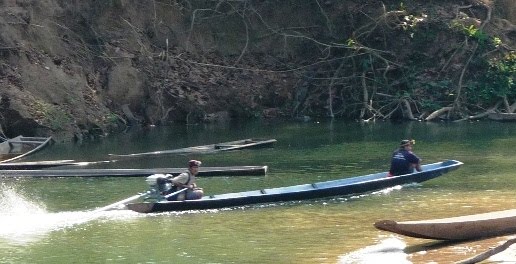
They have to drag me away, but it's time for the next leg of the trek. I and my backpack are loaded into a 'long-tail' boat... a solid wooden plank canoe with a long shaft motor ... just inside the mouth of the cave and we enter another world. This must be what Jonah felt like inside the whale.
-
-
-
The cavern is huge, rising in places to heights of at least 100 feet. With only the lamps strapped to our foreheads, we scan the smooth, ribbed arches and bulging outcroppings around us. At times, the gravel riverbed catches the shallow draft of our boat and we have to get out to push it over shoals and up small waterfalls.
-
-
-
-
It's a welcome and beautiful sight, an hour later, when a distant glow turns out to be the other end of the cave. We emerge into welcoming white daylight and fresh air - and an odd sense in the pit of my stomach, of freedom.
-
-
-
-
-
-
I spend the night in Ban Natan ... a small, agricultural village of solidly built stilt homes accessible only through the cave. (See future post on village life).
-
-
-
That night, as I'm sharing a feast cooked over an open fire with the other trekkers that are staying in the village - from Australia, the US, Japan, Finland, Israel and Germany - we hear a voice shouting. The "white elephants" have come down from the hills and are raiding the village garden. Together we dash out into the fields and from a safe distance watch a mother and young calf destroy a fence and pull up "casava" plants. In the distance, villagers sing and shout, raising a ruckus to scare off other intruders. This is one of the very few places in South East Asia where elephants still survive in the wild.
-
-
We're seen off the next morning by the family, headman and a few curious villagers, and as my fellow trekers climb back into the long tail boats, I'm loaded into an open plastic kayak for the return trip through the cave.
-
-
-
The Trek to Konglore Cave has been an extraordinary opportunity to see an untouched corner of Laos up close, to spend time in the typical stilt villages of the Lowland Lao and to immerse myself in tropical beauty and a natural wonder that few have yet to discover.
-
- 30 -
-

Tuesday, March 6, 2012

The Public Bus to Tha Khek

“VIP Bus broken”, my tour agency driver repeated. “VIP bus broken”.

“What are my alternatives”, I asked wearily. “Hunh?”, a quizzical look. “How do I go to Thakhek”? No response. . “Can I talk to your office?”. Still not getting through. “VIP bus broken”, he repeated.

I shifted uneasily in on the hard bench of the open pick-up truck that had been my transfer to the Vientiane bus station from my riverside guesthouse. Beads of sweat started to roll down my forehead in the still heat. I had been looking forward to stretching out in air conditioned comfort and watching the Mekong valley unfold around me on the5 hour drive to the provincial capital of Tha Khek .

I pointed to his cell phone and mimed a phone call. “Office”.

“Ah!”. He dialed and exchanges a few clipped words, then hands the sticky phone to me. I have the choice, the calm Lao voice intones, between private taxi, $160 US, or public bus, $10 US. I hesitate, eyeing the ramshackle blue diesel behemoth beside us in the yard, its windows open, curtains askew. Oh, what the heck, I think… it might be good for a few anecdotes. “OK” I say to the driver, “Public bus”.

I hand my backpack to someone who seems to want it, and climb aboard, choosing the window seat directly behind the rear door … more air circulation, maybe stretch my legs a bit, I reason, and watch the loading process progress. According to my ticket, we still have 40 minutes to go before departure.
Glancing towards the back, I notice the last 2 rows of the bus are piled to the ceiling with what might be apples in blue plastic bags – a potential avalanche should the bus stop short. A pair of young, saffron wrapped monks appear uncomfortably aware of their danger in the last functioning seats.

A young couple climbs aboard and discovers all seats are taken. But rather than disembark, they shrug shy smiles and prop themselves up at the front of the bus. More arrive … “they’re going to stand for 5 hours?” I wonder to myself”. But then the ‘conductor’ (there are two, one lean, wiry and toothless, the other plump and official looking, in a blue dress shirt) pass in a number of red plastic stools. These are set up in the aisle, and 5 o6 6 people squat down on these precarious perches. It turns out they are the lucky ones.

A truck pulls up, and square, plastic-wrapped packages are heaved onto the floor of the aisle then topped up with square boxes. Next, bags of rice each weighing more than I’m sure I could lift, are dropped on top and tied to the metal poles. Each time a new load of cargo arrives, the people on the red benches stand, shift and resettle. Still more passengers arrive. A young women ties a pink plastic bag of food to the overhead bar and perches with her three little ones on the rice sacks.

As departure time nears, a few of us hop out to use the toilet one last time and buy bananas and bread from the vendors – not likely to get a meal on this flight!

Finally the bus lurches away from the platform… but before it can leave the yard, 3 young men in the latest asymmetrical Japanese haircuts, dash over and climb aboard. They seem content to squat on a few boxes in the remaining space by the exit door, clinging to the support bars at my feet.

“Finally”, I think, glancing at my watch, “on our way”. If it’s 5 hours, like the VIP bus, we’ll be there by 7pm.

But the bus crosses the first intersection and stops. Two more women and several bags of luggage are shoe horned in. We stop 3 more times before leaving the built up portion of the city, and each time, the red stools shift a few inches closer together, and a few more people find perches on the bags and boxes in the aisle. Slim passengers lift arm-rests and squeeze a third thin butt onto a pair of seats. Luckily my tiny seatmate is a little tiger and growls when anyone impinges on our row – even poking a little girl’s bare feet with her toothpick when they stray under her arm-rest.
Five hours into the journey, and still far from our destination, the bus appears to have reached capacity. In the stairwell at my feet, at least 9 people are sqeezed together, the door open to accommodate the skinny conductor and another passenger handing out the opening.

Dusk falls, the air cools. I place a protective hand on my knapsack between my feet. But I sense some cameraderie on this bus. Some complain when yet another passenger is loaded aboard (primarilyy from my seatmate the tigress), but most accept the situation with a shrug and a shy half smile.
In the end, the trip takes 8 hours. Not quite the relaxing cruise through the countryside I had anticipated, but I arrived in one piece. The skinny conductor knew exactly which of the various cargo holds my backpack had fallen into and I shared a pick-up truck taxi into town with a man carrying a bag of eggs, and a young temple boy named Nhoi.
Certainly an experience worthy of anecdotes.
-30-

Tuesday, February 28, 2012

Singapore - City of Order and Contraint


The gleaming glass towers of Singapore form a cordon around the green canopy and red tile roof of the colonial district. The view from my window is expansive … from the Strait of Singapore on my left, shimmering in the sun, studded with legions of ocean freighters, across the green sward of the Padang and colonial St. Andrew’s Cathedral, to the forested bulge of Fort Canning Park on my right.

The modern architecture is startling – I.M. Pei’s two-dimensional Gateway towers; the three towers of Marina Bay Sands, precariously supporting the massive, boat-shaped sky park; Norman Foster’s Supreme Court flying saucer; the organic durian shapes of the Esplanade Theatres by the Bay.

The famous Raffles Hotel squats across a full city block, recessed, arched walkways articulating it’s 3-stories and encircling palm shaded court-yards that echo with Somerset Maugham and Noel Coward colonial Britain.
Broad shaded avenues serenely shoot out from the city centre, past ultra modern, glass condo tours and colonies of the hillside, gated homes of business and civic elites. Large communities of well-paid ex-pats live a comfortable life here, with good schools, excellent health care and little fear of crime.
It’s a neat, orderly, well-behaved city. A shopper's delight, a foodie's haven. Little traffic congestion, no horns, not a splash of graffitti, not a stray tropical leaf under the manicured sidewalk plantings. It's an idealized, utopian city - and easy to forget that it sits at the tip of the Malay peninsula, guarding the pirate infested Straits of Malucca and a short hop from fabled, untamed Borneo.
But there are pockets of stunning equatorial beauty. The botanical gardens harbour a fenced 6-hectare old growth rain forest and the compact, orderly National Orchid Garden is a mere 15-minute walk from the upscale Orchard road shopping district. Roof-top garden's spill bright colours and greenery over rigid walls; potted flowering trees line sidewalks and mark patios.

And beneath the surface, a colourful past. At a cross-roads between east and west, Singapore merged Portuguese, British, Chinese and Indian cultures with the local Malay resulting in the multi-faceted Perenakans – a rich blend of languages, traditions and cuisines that is now celebrated.

Utopia requires a balance. There is clearly money here - full employment, no visible homelessness, subsidized housing for all. But the rules in this semi-autocratic principality are harsh and unbending. Opposition is curtailed (the park with the city's "Speaker's Corner" also contains a police station). Long-term planning streams children towards needed occupations at a shockingly early age. Penalties for transgressions are draconian - the death penalty for drug dealing, deportation for frequenting prostitutes, huge fines for chewing gum, $80,000 to license a car that is over 10 years old.
It's a good place to live I'm told. As I look out over the the sparkling city the activist in me debates the citizen - wondering if the trade-off between order and constraint is worth it.
- 30 -

Saturday, February 25, 2012

Girding for travel


Like a warrior girding for battle, I slip into my familiar travel armour: Tilly pants with hidden passport pockets; cotton 'T' to protect my North Face Travel Shirt for another wear; worn hiking boots that have seen as much of the world as I have; layers of fleece and wind protection that peel off as I hop across to Japan, then south to equatorial Singapore.

Francisco has scrubbed the house and set out a welcome bottle of wine for our house-sitter, then dropping me at the airport with an admonition to travel safely and sanely. Skype and blog will shorten the trans-global distance.

There's a familiar routine about this now, but a still a nervous stomach. I bolster my bravado with travel cliches. "Ships are safer in the harbout, but that's not what they were built for". "The world is a book, and those who do not travel read only one page."

Sitting in Pearson's Maple Leaf Lounge, a comforting reward for transporting licorice and PJs to a colleague's ex-pat sister, I take a deep breath. The hotels are booked, the transfers arranged... and all I have to do is wait to be taken away.

-30-

Monday, February 6, 2012

Another Count-down - Laos


News Flash! I leave on Feb. 25th for Singapore and on to Laos. Along the way, I will try my best to keep you up to date on my progress, relaying stories of the people and sights I encounter. Check back in here from time to time to follow my stories.

Love you all,
Jordan

-30-

Monday, October 3, 2011

Above the relentless torrent - Vatican Museums


Shoulder-to- shoulder, breast-to-back, the hoards shuffle through the narrow corridors, eyes down to avoid stepping on heels, occasionally glancing guiltily over each other’s heads at the skilfully carved stone or finely painted maps that decorate the walls of this rigid channel.


Tuned in to the guide’s rapid-fire explanations, they nod automatically – as long as they can hear her on their earbuds, they know she’s within radio range.


In front of priceless Flemish tapestries, monumental figures battling over delicate landscapes; arms raised with iPhones and long-lensed cameras fire flashes that fade the delicate colours.


Logjams gather where families pose for photos with historic frescoes of famous battles and martyrdoms.


Raphael and Fontana, Bernini and Boromeo fail to register.


The relentless flow pushes past a collection of modern art – ignoring Chagalls and Dalis only steps away – and spills through a small doorway into the celebrated Sistine Chapel.


Straining our necks, we peer upward into the vivid colours and taunt muscles of Michelangelo’s angry old God, jostled by the endless flow of new arrivals, assaulted by uniformed guards shouting for silence.


But this time, the Chapel wins out. Despite the restless carpet of upturned faces, the azule-backed Last Judgement swirls hefty nude figures of saints and sinners around a dynamic Christ, stepping out into the soaring space in Renaissance 3D.


If we stop… and take a deep breath. If we block out the bored children and offensive guards … and focus on the massive, fleshy figures emerging from the deep blue wall, they begin to breath. Silken drapery shifts over flexing muscles, fiery eyes seek you out, outstretched arms twitch as the screams of the damned lift above the forbidden tourist din. Michelangelo, this sculptor turned painter, created life on another plane. His genius lifts us up above the shuffling crowd and waving batons of the guides, and for a moment, the indignity is worthwhile.

-30-

Sunday, October 2, 2011

Roman October

I lean my head back and close my eyes. The sunlight splashes against my closed lids, dappled by the broad leaves of the plane trees overhead. The hot sun of a Roman October warms my face, tempered by an exquisite chilled breeze.

For minutes I let the sun-shadow patterns play across my lids, then lift my head and look around.

From my perch on top of an open-air tourist bus, I watch the newsreel of Roman monuments move majestically by me.

• The wedding cake monument to Vittorio Emmanuel, first king of a united Italy, starkly white against the endless Mediterranean sky;

• the broad plane of Circus Maximus where roman chariots once raced below the terraces of the Palatine;

• the jewel-like bridges over the Tiber – rhythmic white arches over the swirling dark waters, topped with clusters of carved marble figures;

• the brutish Castel San Angelo , built to be Hadrian’s tomb but fashioned into a defensible Papal retreat;

• the elegant, square-domed synagogue on the banks of the Tiber proclaiming the old Jewish Quarter around Campo de Fiori;

• and at the top of the Via della Conciliazione, grand fascist avenue from the 30s, squats St. Peter’s, its pincher colonnades and regal façade by Bernini drawing the eye into Michelangelo’s magnificent dome.


The bus lumbers through the broad avenues of the Italian capital, under the warm October sun – cruising Via Veneto , Via Cavour, and Via Nazionale, leaving the sights in amongst the tangled alleys – the Pantheon, Spanish Steps and Trevi Fountain – for another day.

But the cruising bus gives me a piano nobile view of the magnificent palaces and exquisite churches, the lush umbrella pine trees over picturesque squares, and clustered sidewalk cafes where elegantly dressed romans share space with shorts-clad, t-shirted tourists.


I’ve walked miles in Rome, and have photo-album memories of its main sights. But never before have I sewn it all together, seen the interplay between ancient, renaissance and modern, felt the flow of the neighbourhoods, understood the relationship between Santa Maria Maggiore and St. Peter’s, the Forum and the Coliseum.


Under the sun of a Roman October, the city begins to make sense to me.

-30-


Saturday, October 1, 2011

Slipping into an old skin

I’ve been sedentary for 5 months now, settled back into a comfortable routine of work, rowing and occasionally family. The summer in Toronto has flown by in a warm, sunny blur, mostly seen through windows , and autumn rushed in shrouded in dark, heavy rain clouds.

But today, I’m sitting at the airport, my trusty and now worn backpack at my ankle and my old netbook companion balanced on my knees. I feel a warm loosening in my shoulders – tension slowly easing out of my muscles. Why, I wonder, does the hassle of travel feel so good?

When I had returned home from my southern hemisphere travels this spring, I had been surprised by the speed with which I had re-acclimatized. I was back at work and happily writing reports within days. Had the vagabond feeling of the world traveller evaporated so quickly?

“It must be hard to be back”, friends and colleagues announced. Nope.

According to Michelle, my penpal/sister in Argentina, the transition was eased because I had been able to create two “me’s” – a notion I relish. I’ve come to call them ‘home Jordan’ and ‘travel Jordan’. Rather than having to re-adapt to life on the road, I simply slip into my other ‘me’ and I’m on my way.

So today, I’m heading off to Rome with a few pieces of clothing in my backpack, and 9 days to meander. Coming with me on my journey, my partner and seasoned fellow-traveller Francisco, and his mother and aunt –both happily warbling about seeing the Vatican.


Photo: Francisco and his mother keep "Thor" company at the airport.