Monday, February 14, 2011

A Day in the Delta

Ines and Julian greeted us as if we were long lost friends, both of them leaning in to grip our shoulders and kiss each of us in turn on one cheek. “Che! Bienvenidos chicos!”

Both sun-bronzed and athletic, they were either well-preserved ’70-somethings’ or weather worn ’60-somethings’. We had seen Ines earlier at a local restaurant, so we knew their bathing suits - Ines’ tiny bikini and Julian’s more modest trunks – were everyday wear here in Tres Bocas, a scattered cottage community about 45-minutes out into the delta of the Rio Parana.

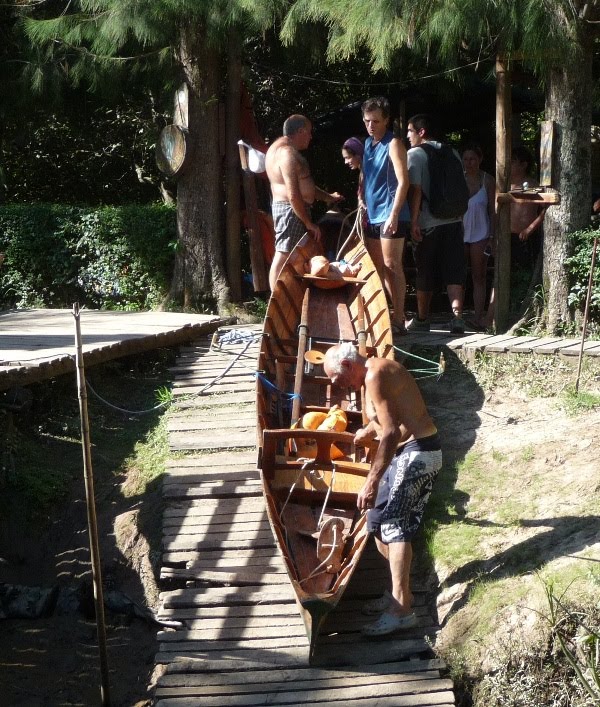
Ines showed us the magnificent wooden rowing shells that she rented out to anyone who wanted to row in the island’s shallow, muddy channels.


Julian gave us a quick tour of the tiny, stilted cottage he had built himself out of corrugated metal and large sheets of glass, and painted an ecstatic yellow. On the lawn nearby, a number of friends reclined around a table bearing the remains of a huge mid-day meal.


We had found our way to their little compound by following the beaten footpath along the “arroyo santa rosa, sobre margen izquierda”, the left bank of the Santa Rosa creek, intrigued by signs offering ‘Learn-to-Row’ lessons. The winding channel was about 15 feet wide and it’s stagnant, chocolate milk waters kept its depth a mystery, but it didn’t look like a very welcoming rowing course.
Along the way, we had admired the hodgepodge of stilt cottages, tall docks and worn watercraft, and had wondered at the mix of people we saw lounging under the scraggly shade trees: preppy professionals on a weekend away from Buenos Aires, aging ‘hippy’ couples like Ines and Julian, pretty gay boys enjoying a polished meal on their dock, boisterous blue collar types fishing in the murky waters, broad-shouldered transvestites gossiping on a porch, muscular teens at their summer jobs in the marina.

This was clearly one of the fabled “edge-of-the-world” communities that I enjoy discovering in my travels; places like Provincetown, Key West and Wreck Beach that take their beyond-the-end-of-the- line isolation as an invitation to break the constraints of a more conservative society.
And Tres Bocas is certainly beyond the end of the line. My buddies Gustavo and Juan had accepted my invitation to take a Sunday excursion to Tigre. It’s a riverfront town about 45 minutes north west of Buenos Aires, following the banks of the Rio de la Plata on the suburban commuter train (a 40 cent fare).


Tigre itself is famous for its Naval museum, its Puerto de Fruta market (more furniture and handicrafts than fruit), and to my delight, over-the-top 19th century rowing clubs. The elite “Buenos Aires Rowing Club” actually looks more like a Scottish castle than my simple brick club in Toronto.

At the water terminal’s “rampa 1”, we boarded a “Lancha colectivo”, one of dozens of sculpted wooden bus-boats , circa 1945, that serve the channels of the 200 square kilometer delta where the Rio Parana meets the Rio de la Plata.
The lanchas plow through the muddy waters at top speeds, blowing their horns at private boats, barges, jet skis and rowing shells carrying families of eight (no kidding!) that stray into their paths. Their wakes bounce off the channels’ walls and form stupendous, intersecting waves and troughs. To my rule-ridden mind, it is a “quilombo”, chaos.


The lanchas stop at any dock where someone waves them down, reversing into the hanging stairs just long enough for a passenger to hop ashore or aboard. On this warm, sunny Sunday, there are many stops.

The scenery from the comfortable seats of the lancha reveals a democratic summer community. There are fancier homes, with very-English manicured lawns, leaning shacks with tumble-down docks, campground beaches full of noisy families...

Juan, Gustavo and I had hopped off the lancha colectivo at Tres Bocas – three mouths, where three channels meet – and spent the afternoon wandering the footpaths of the island.
Our mid-afternoon meal, huge servings of grilled diaphragm (entrana) and ‘loma’ on the tree-shaded patio the El Hornero parrillo, was a slow, relaxing affair with ice-chilled white wine and plenty of human scenery.

By the time we boarded the lancha back to Tigre, we had each convinced ourselves to come back: Juan to spend 15 days reading, Gustavo to explore other islands, and me … to take up Ines’ invitation to go rowing along the winding channels of this “edge of the world” little community.


-30-


Tuesday, February 8, 2011

The Happy Barber of Belgrano

I needed a haircut. It was a big, old barbershop with three large metal chairs facing the mirror along one wall, a long burgundy naugahide banquette along the other, and what looked like a cappuccino bar in the centre. A tall teen with luxuriant brown curls had just climbed into the chair and the rotund, old barber was about to get started.

I stopped at the chain barring the entrance. “Esta abierto?” I asked. Are you open? The barber grinned – four widely spaced yellow teeth showing on his lower jaw. “En cuanto termino con esta muchacho”, he said, removing the chain and indicating the banquette.

His strong, steady hands never stopped snapping the scissors as I watched the boy’s gorgeous curls tumble to the red and beige tiled floor. He was very familiar with the boy, teasing and cajoling, occasionally poking him as he turned a tousled teen into a handsome young man. He was steady, accurate; clearly a lifer.

“Es mi nieto” he proclaimed proudly as the young man stood and shook off the stray hairs with a grin. This is my grandson. So much for figuring out how this was going to cost me, I thought, as the boy loped out the door with a wave.

I climbed up onto the comfortably padded chair and tried to explain what I wanted. “No muy corto”, I stumbled. “La mitad,” I indicated half of its current length.

He picked up the electric clipper. “De Allemania” he bragged, German engineering. “Numero tres” I almost shouted, please use a ‘number three’. I was thinking of a Tango song we’d listened to in class this morning about a man whose lover had robbed of everything: “me pelaro con la cero” – shaved me with a zero, left me with nothing.

For the next 45 minutes, 79 year old Teodoro Iglesias (“Julio’s my cousin”) entertained himself by telling me about his happiness – cutting hair for 50 years in this neighbourhood, and seeing more of the world through his customers’ eyes than he ever would have on his own. He would pause after every third clip, and move out in front of me, gesticulating wildly with the 8” scissors only inches from my face. “Me entiende?” he would ask. Do you understand? And I’d grin and nod, even if I didn’t.

After a while, I began to suspect he wasn’t all there. He’d lose track of where he was, and spent an inordinate amount of time on my left side, closer to the window where the light was better. Occasionally he’s lean over, his mouth inches from my ear and raise his voice to a pain-inducing shout.

Then the straight razor came out.

He stared intently at me. With a toothless grin he unsheathed the blade from its ancient ivory sheath and held it an inch from my nose. “Unhunh?”, he asked. The two interlocking figures of Zwilling J.A. Henckels. “Bueno”, I said, trying to grin. My eyes closed in a wince as he paused, holding my ear. I heard rather than felt the scraping of the blade across my skin. After a few strokes, he held the blade up in front of me again. “Unhunh?”, he asked again. I wasn’t sure what he wanted approval for – little specs of black hair? No blood? “Bueno”, I said.

He stood staring at me, his smile draining away. Clearly I was missing something. I grinned widely, trying to get my eyes to participate. He chortled and returned to his scraping.

“Learning is a wonderful thing”, he said in Spanish, almost to himself. “I was trained by the Jesuits in Santiago de Compostela. You have to keep learning every day”. He clearly approved of my attempt to learn his language and didn’t mind that I wasn’t following everything he was saying. “Keep learning”, he repeated.

I left the shop, and strode down Avenida Federico Lacroze, happy with my latest accomplishment. A haircut! I wondered when the happy (and perhaps a little mad) barber would have his next paying customer.

I didn’t even mind the fact that I felt more of a breeze on one side of my head than on the other.

-30-

Saturday, February 5, 2011

La Milonga


His gaze is intense; dark, deep eyes staring steadily under heavy black eyebrows. His dark hair, black with a touch of silver, lies in limpid waves glistened under the lamp light. He wears a simple loose white shirt, unbuttoned just so, and tailored black pants that end in ebony shoes of soft leather.

He clutches the blond woman to him, her long ringlets brushing his cheek. Her camisole, a flimsy black chinoiserie, hangs loosely from her ivory shoulders and reveals most of her back. As they move, her diaphanous white skirt amplifies the swaying movements of her hips, and teases shadows of flimsy lingerie underneath.

They dance, alone in a crowd, across the smooth stone floor. They dance without words, without choreography, led only by his instinct, by his feel for the music. They dance the Tango.


It is Friday night in ritzy Barrancas. The nearby streets are lined with exclusive apartment towers, second tier embassies (Austria, Turkey, Vietnam, Hungary), and the noble townhouses of the mildly wealthy. But here in the worn park, the Victorian iron band shell with the polished marble floor – the Glorietta – has been converted into a much more democratic community Milonga.

A hunchbacked man with prominent teeth and thick glasses has set up a sound system and settles down to play the instantly-recognizable heavy beats of tango music. A tall skinny woman in black jeans and a tight pink t-shirt has just squeegeed what might be last night’s vomit from a corner of the black and white floor and is now setting out tiny plastic stools around the periphery. As the dancers arrive, they are greeted by a blond, rouged woman of indeterminate age, in a flouncy paisley skirt. She holds up a donation can, asking 5 pesos ($1.25).


Most of those who climb the steps onto the band shell are in their 60s and 70s and arrive alone. They seem out of place in this ritzy neighbourhood. The men are clad in simple, short sleeved shirts and comfortable pants – the types who would hang out in the local tavern and watch the futbol game over a beer. I’m surprised to see so many of them here. One gent tries to explain the attraction for him. “It’s like a drug” he says. “Once you hold a woman in your arms like this, and guide her around the floor, you can’t get enough of it”. And before I can ask a question, he’s off to dance with a blond woman a foot taller than he is.


The women, with their hair teased and highlighted and make-up applied with a heavy hand, with their clothes a little too tight, or short, or low cut, seem slightly déclassé. The woman with the diaphanous skirt should probably be wearing a slip. The woman who keeps smiling at me and finally asks me to dance might be more comfortable in a dress a few sizes larger.

Tango was born in the brothels of the waterfront La Boca neighbourhood, sibling to the Argentine slang called Lunfado. It was originally danced only by men and cannot shake off its lowly origins.

A woman in a severely masculine haircut and pants has wandered up onto the Glorietta and sits on the stool beside mine. She leans over and in a half whisper, confides “my son would kill me if he knew I’d come here to tango. These women, they are just…”. She doesn’t finish her sentence and slips away minutes later.


As the light fades, and more people arrive, I see younger dancers on the floor, many of them gliding by silently in the arms of men or women old enough to be their grandparents. The footwork is intricate and individual, improvised to the sensuous music. Every 2 or 3 songs, following an unwritten rule, the partners change. Requests and acceptance are made with glances and raised eyebrows. Few words are exchanged.

As the dark night approaches, I turn away and head home for dinner. The Glorietta has taken on a warm glow in the lamplight. The sensuous, swirling couples on the raise platform are a self-contained little world; Tango set apart from the modern bustle of the urban park.


A fleshy woman packed into a black satin dress, closes her eyes, and tilts her unlikely auburn head back slightly, lost in the dance. He pulls her close, his intense gaze fixed on a distant mystery. With sweeping movements, he glides her across the floor, stopping, rotating her back and forth with strong arms, stopping again to lift one of her feet with his, then continuing the glide. The other couples each lost in their own sensual dance, move in different rhythms, different speeds, different thoughts. Different but together in the Tango.

-30-

Wednesday, February 2, 2011

Seven things that are different...

On the surface, Buenos Aires looks like any other city of the Western World – a very beautiful one, of course. But the more time I spend here, the more I start to notice things that are unique. Here are few observations from the end of Week Two:

1. El cielo / the sky. The clarity of the sky is hard to describe. The blue is translucent, liquid – it seems to have a third dimension, a depth. But strangely, the bright sun bleaches colour out of the quadrant it occupies. The other evening, I turned around and was stopped in my tracks by the flat, white glow at the far end of a downtown canyon – as if a photographer had dropped a reflective sheet between the buildings.

2. El sol / the sun. It’s strong. It could be a cool 20 degree day with a lovely breeze, but as you step out of the shade, you’ll notice a physical pressure on your skin, a warmth with weight. “The hole in the ozone from the Antarctic”, I’m told.

3. El aspecto fisico / Looks. There are beautiful people here. Lots of them. And there are many, many business dedicated to maintaining them. I would guess that 40% of all storefronts near the school are depilation salons. Those that are not, teach Pilates.


4. Los perros / The dogs. There are dogs everywhere. All shapes, sizes and breeds. Their constant barking, frantic howling and staccatto yapping from behind closed doors and shutters is this middle class neighbourhood's low key soundtrack. Through the day, they emerge in clusters, their leashes wrapped like maypole ribbons around the arms of grim-faced dog walkers. Yesterday I saw one virtually spread-eagled by 15 dogs, each pulling towards a different compass tangent. They seem to spend their "park time" tied to fences. No one picks up after them.

5. Las Colas / The line-ups. Portenos are very orderly. I’m told that if there are two people gathered anywhere, they form a line. I was most surprised by drivers at a very large gas station. Rather than crowding the plaza and jostling to be the next to a pump, drivers formed a line out on the street and down the block, waiting until a car left before even driving into the plaza.


6. El Anden / The Sidewalk. It seems that homeowners are responsible for building and maintaining the sidewalks in front of their buildings. This means that every 10 paces, you encounter a different colour, texture, condition, even level. Two reasons to walk with your eyes glued to the ground: Dog poop and constantly changing sidewalks.


7. Los pobres enprendadores / The enterprising poor. Perhaps it's an aftermath of the economic meltdown decade ago or perhaps the lack of a tranquilizing safety net, but there is a class of hard-working poor that are constantly present:

a. Recyclers: Skinny, sunbaked men - sometimes accompanied by wives and children - pull 2-wheeled carts holding immense canvas sacks through the streets of even the best neighbourhoods, stopping at dumpsters and garbage cans to methodically sort out and collect paper, cardboard, metal – whatever material they are selling for recycling.

b. Subte vendors: Salesmen of all shapes, ages and skin tones, stand in the middle of moving subway (Subte) cars and deliver a carnie patter extolling the benefits of a rubber toy or children’s book, hoping for a sale or two before they move to the next car at the next station. Young women and grubby children walk the length of the car dropping packs of gum or pens on laps and return for them, or a cash purchase, before the station.


8+ - There are bound to be many, many more interesting differences that pop out at me as I spend more time in Buenos Aires....

Sunday, January 30, 2011

Sunday Afternoon in Plaza Mafalda

The humid summer air sits heavily on Plaza Mafalda. The mid-day sun, high in the crystal blue sky washes the little urban square in a white heat.

Under the spreading plane trees, young couples barely clad, have spread white sheets on the beaten grass, playfully photographing each other with cell phones and sharing cups of hierba mata. Young parents clack by in flip-flops, pushing a carriage with a black-haired baby that could be cartoon Mafalda herself.


In the far corner of the park, a group of young men, stripped to the waist and drenched in sweat, have just finished a friendly game of futbol and are jostling loudly over attentive girlfriends and sweating bottles of chilled cola.


Nearby, an older, white-haired couple sits primly on a hard wooden bench, gently gesturing in conversation. Two attractive middle aged men walking fancy dogs exchange cheek kisses, revealing nothing.


The thick air is both quiet, and filled with a distant soundtrack that mingles the screams of excited children in a nearby community pool with the ceaseless barking of confined, frantic dogs.
This is not one of Buenos Aires’ show-piece plazas. It’s not pretty. A few trees have died, the grass has been beaten to dirt in places. Freshly poured concrete walkways lead to a construction fence where the central plaza is torn up. The barely stirring breeze carries pungent waves of dogshit.
No, it is a middle class park, a back yard for the hard-working Portenos who live in the airless towers around; those who can’t join their wealthier compatriots on a summer exodus to the beach. It is here that they come as the air cools at the end of a hot Sunday afternoon to walk their dogs and see their neighbours.

I spend the afternoon sitting in this worn little park below my apartment window, listening to the italian musicality of the Argentinian accent, starting to pick up more than a few isolated phrases. For a moment, I try hard to believe that I’m not a tourist anymore, but a resident; a still-isolated new-comer unable to strike up a conversation with the sweating neighbourhood around me.

Saturday, January 29, 2011

My stomping ground

View from my bedroom window (left); My building (centre); My room (right) .


AMAUTA - my school (left); My favourite lunchspot (centre); My gym (right).


Best Parrilla (grill house) yet - El Establo, corner of Paraguay and San Martin.


Friday, January 28, 2011

Las casas de Belgrano / The Houses of Belgrano

From its oldest neighbourhood - the still sketchy San Telmo - Buenos Aires grew northwards along the shore of the Rio de la Plata (River of Silver).

When yellow fever hit the young city, the wealthy fled, leapfrogging the train station district in Retiro and carved the fancy neighbourhood of Recoleta out of the countryside.

Its neighbour to the north is Palermo, subdivided into trendy zones called Palermo Soho, Palermo Hollywood and Palermo Viejo. Today the once-bohemian hangouts around Plaza Serreno are avant-guard clothing shops selling expensive t-shirts and ‘bermudas’, overflowing restaurants serving big slabs of meat, and ‘too cool’ bars where locals and tourists vie for spots at the sidewalk tables.

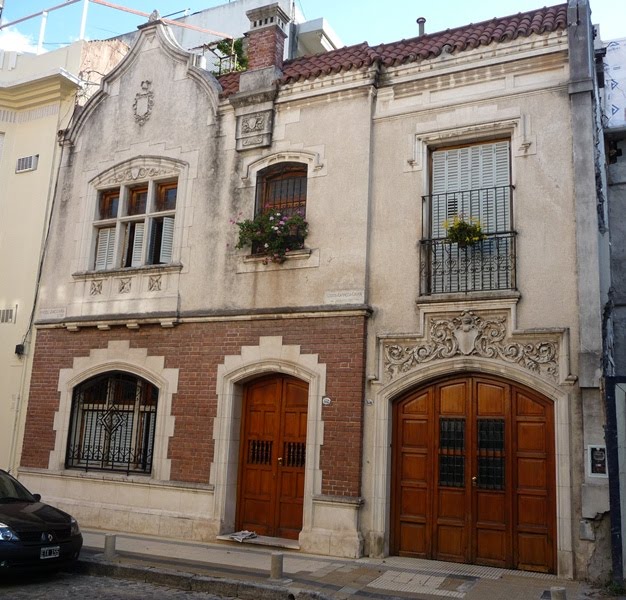
Just beyond Palermo is my neighbourhood – the elegant, residential Belgrano. It is a huge grid of leafy residential streets that once boasted the elegant, architect-designed home of the upper middle class. “Revival styles” appear to have been popular – Beaux Arts, Classic, Gothic, Romanesque, even Tudor.

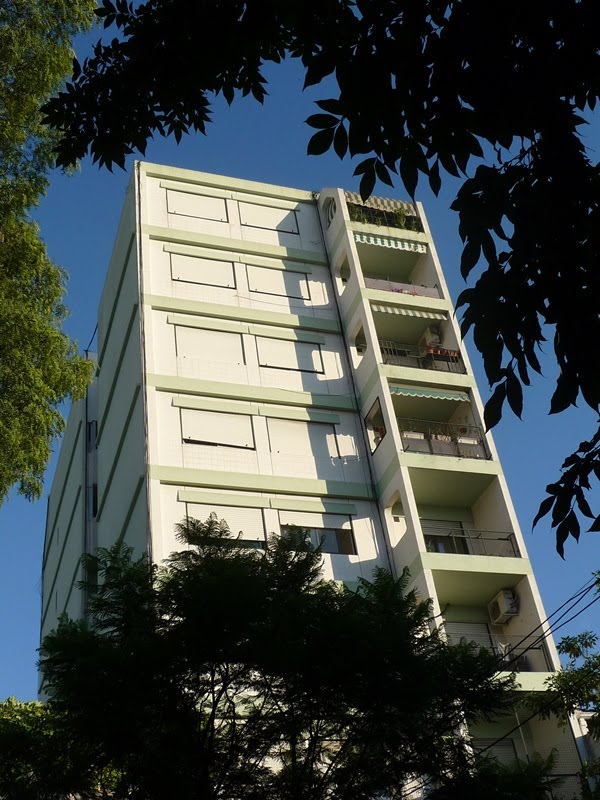
Today, elegant renovations of these compact mansions sit shoulder-to-shoulder with tall, narrow mid-century apartment towers, built on the footprints of demolished homes.

Here are a collection of some of the lovely old homes I walk by every day…


Todo contra la sobriedad

I wrote a poem for class this morning - with apologies to Gloria Fuertes and her poem "Todos contra la contaminacion". The exercise was to practice the subjuntive tense, but I was still a little buzzed by last night's bottle of white wine (with a slab of meat on a roof top terrace in Belgrano, of course). Apologies for the lack of accents, but my little netbook doesn't seem to have that function.

Todos contra la sobriedad

Que no sepas nunca la joya de descansarse
Que no tengas nunca la oportunidad de encontrar alguin diferente, alguien que nunca encontraria en su vida normal
Que no reis nunca sin razon, sin parar, hasta que te duela tu estomago, sin razon ...
Que te acuestas todos las mananas con memorias intactas, sin la selectividad dulce de cosas olvidadas.

Tuesday, January 25, 2011

The Cell

At the bottom of a deep pit, in a small, airless chamber, a lonely man lies, limp, on a tiny bed. The stifling air weighs heavily on him; his thin pillow and threadbare sheets are damp with sweat.

He can hear the voices of others, filtering down through the pit, but his only company in this crude cell are the mosquitos who have found him through the cracked glass door, left ajar in the hope of some movement in the air. Black smudges of their unlucky ancestors are smeared on the sticky yellowed walls.

Scattered around the chamber, his few sparse belongs lie in disarray, abandoned in despair.

As he struggles to breath, the sodden air develops a sickening, smoky texture. He shifts, rolling onto one side, trying not to imagine the horrors that lie ahead.

Hope is an effort.

His guardian, a skeletal witch with clacking dentures, has laid out his evening meal – a scrap of blackened meat and parts of a potato. She barks abuse at him, knowing he won’t understand, perhaps trying to unburden her own blackened soul.

He spends a sleepless night, trying hard to imagine the sparkling sea, vast prairies and soaring mountains beyond the walls that enclose him. He forces himself to construct a film in his mind; he is riding a horse through a verdant mountain pass, following a sparkling mountain stream to a place with crisp, cool air. But the image is fleeting, leaving him, dropping him down once more onto the tiny, damp bed.

At first light, he dresses quickly, collecting his belongings and escapes the cell, wandering burdened through the wakening city.

And then hope arrives. At Spanish school yesterday, the lonely, desperate man had unburdened himself to a sympathetic school administrator. Today, she tells him, you’ll move to a new “family”. With some trepidation, and a constant supply of Mate* he forces himself to concentrate through his classes, and then follows the administrator’s directions to his new home.

The door opens to a 6th floor aerie of polished wooden floors and crisp white walls. An older women, smiles warmly, her black and silver hair gathered elegantly into a loose bun. She leads him to his room – a gentle space decorated for a son who was once a teen; colourful sheets, crisp and clean, a broad white desk, shelves of books – Latin American authors and politics. A wall-to-wall window is flung open to the cooling breeze and a broad view of the city’s skyline.

Exhausted, he falls into the bed, and sleeps, soundly, awaking an hour later to see a vivid rainbow glowing over the city.


(* Mate ('mat-eh')- an herbal infusion consumed continually by Argentines, often passing a single 'bomba' around a group. "Mateine" seems to have an effect similar to "cafeine")

Sunday, January 23, 2011

Photos from a weekend in Buenos Aires

Avenida Cabildo near the school. A Palermo townhouse. The San Telmo market.


Plaza de Mayo (the Cabildo). Street corner in the MicroCentro.


Trying to understand our Spanish. MicroCentro rooftops